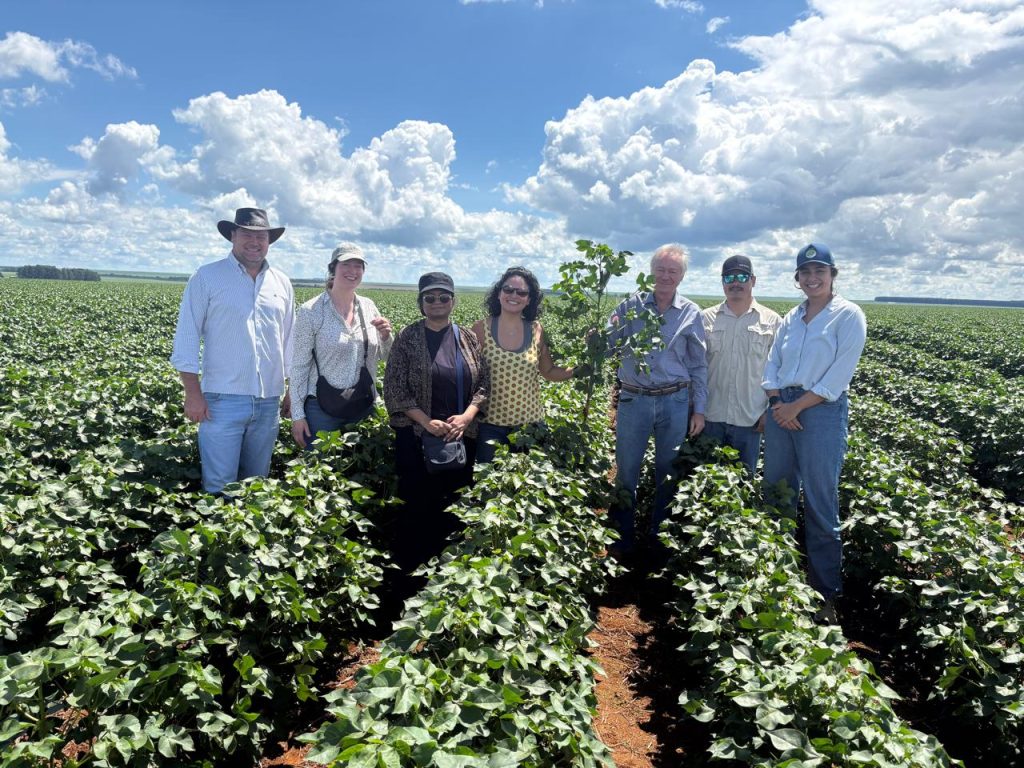
The delegation visited cotton farms in Mato Grosso and concluded the visit at the association’s headquarters in Brasília.
The international organization IDH carried out a technical mission focused on Brazil’s cotton value chain. The delegation—composed of professionals from Brazil, India, and Europe—included technical visits to cotton farms in Mato Grosso, as well as a strategic meeting at the headquarters of the Brazilian Cotton Growers Association, in Brasília.
According to IDH’s project supervisor in Brazil, Aline Silva, the goal of the visit was to develop a strategy for the organization’s work in the country. “Based on insights gathered from research, bilateral discussions, and field visits, we aim to structure a strategy for IDH’s engagement in Brazil’s cotton value chain at scale,” she explained.
Immersion in the state of Mato Grosso
During the field visits, the team closely observed the sustainability standards that position Brazil among the world’s leading producers of certified cotton. In Campo Verde (MT), the delegation visited benchmark production units alongside the Mato Grosso Cotton Growers Association, with special emphasis on Fazenda Santa Rosa, owned by producer Alexandre Schenkel.
The visit enabled IDH’s international representatives to validate traceability systems, efficient resource management practices, and the strong commitment to environmental preservation that underpin Brazil’s cotton sector.
“Hosting IDH on our farm is a way to demonstrate the producer’s commitment to Abrapa’s socio-environmental responsibility goals. We are not only producing fiber or food—we are generating production data, preserving water resources, and ensuring that the international market receives a product produced with ethics and social responsibility.”
During the visit, the aspects that stood out most to the group were the use of biological pest control solutions and the traceability of cotton bales produced on the farm.
For Schenkel, this level of transparency is essential to strengthening the global positioning of Brazilian cotton and building momentum toward a more sustainable future. “This exchange of experiences shows that Brazil’s agricultural sector plays a key role in addressing the climate and social challenges of the modern world. We are joining forces around natural fibers, contributing to a more sustainable planet for future generations,” he emphasized.
Visit to Abrapa
The visit concluded at Abrapa’s headquarters in Brasília, where discussions focused on consolidating field insights and exploring future collaboration opportunities between the association and the international organization.
According to Abrapa’s sustainability manager, Fábio Carneiro, “Visits like this—covering a farm certified under the Brazilian Responsible Cotton program (ABR) and concluding here at Abrapa, where we support the implementation of traceability, sustainability, and quality programs—are valuable opportunities to share our experience and engage with key stakeholders across the global textile value chain,” he said. “As a pioneering program that is continuously evolving, this dialogue is essential for the future of ABR.”
About IDH
IDH works to transform markets through collaborative innovation, bringing together stakeholders and investing in inclusive and sustainable solutions that generate value for people and the planet. The organization builds coalitions across global value chains, promoting shared visions and advancing sustainable trade agendas.
With an international presence across multiple regions and strategic sectors, IDH has mobilized private-sector investment over the past 15 years to test and implement new business models that drive better jobs, higher incomes, environmental balance, and gender equity.