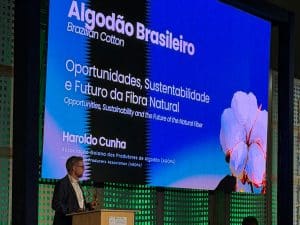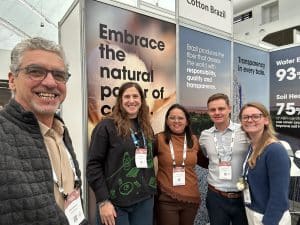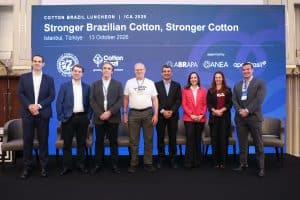

Lisa Ventura, Head of International Partnerships at Brazilian Cotton Growers Association (Abrapa), frequently participates in global events representing Brazilian cotton. On these occasions, she often receives a wide range of questions about production in the country — especially related to sustainability and innovation.
In this Q&A, Lisa answers the main questions and sheds light on aspects of Brazilian cotton that are still not widely understood internationally.
1. If cotton production is growing so fast in Brazil, what happens to land use and deforestation pressure?
Lisa Ventura explains that the growth of cotton production in Brazil is driven primarily by productivity gains rather than the expansion of agricultural land. “In Brazil, growth is about producing more and better on the same land, not expanding into new areas,” she says.
Cotton is mainly cultivated in the Cerrado region, on already consolidated farmland, where around 85–90% of growth comes from higher yields and the adoption of double-cropping systems, not land conversion. It is common to harvest two to three crops per year on the same hectare, typically rotating soy, maize and cotton.
In addition, the Brazilian Forest Code* requires farmers to preserve between 20% and 80% of native vegetation, depending on the biome, which strictly limits legal expansion into natural areas. Today, satellite monitoring and rural environmental registries cover nearly 100% of large rural properties, reinforcing compliance and transparency across the sector.
2. Cotton is a thirsty crop. How can Brazil be considered sustainable in water use?
Lisa Ventura notes that the idea of cotton as a “thirsty crop” reflects predominantly irrigated production systems around the world, not Brazil’s reality. “In Brazil, cotton depends mainly on rainfall, not irrigation,” she says.
Around 90–92% of Brazilian cotton is rainfed, according to a global study by the International Cotton Advisory Committee (ICAC), with only a small share — roughly 8–10% — relying on irrigation or supplementary irrigation, mainly in specific areas of the Cerrado. As a result, Brazil has one of the lowest levels of irrigation dependency among global cotton producers, with a water footprint largely based on green water (rainfall), rather than blue water from rivers or groundwater extraction.
3. Is regenerative agriculture really part of Brazilian cotton, or is it just a new narrative?
Lisa Ventura emphasizes that, in Brazil, regenerative practices are not a new trend, but are already embedded in mainstream production systems. “What many call regenerative today has long been part of how we farm in Brazil,” she says.
More than 95% of the cotton area operates under no-till or reduced tillage systems, and crop rotation is adopted across 100% of cotton farms, typically following soybean–maize–cotton cycles.
These practices contribute to consistent improvements in soil health, including increases of 15–30% in soil organic matter over time, based on multi-year studies in the Cerrado, as well as up to a 50% reduction in soil erosion compared to conventional tillage systems. In addition, the use of soybeans in rotation helps reduce the need for synthetic nitrogen, while cover crops are widely adopted to enhance carbon retention and improve soil moisture stability.
*The Brazilian Forest Code is a comprehensive legal framework for regulating land use and protecting native vegetation, seeking to reconcile agricultural production with environmental conservation. Read more here.