In its provisional phase, the free trade agreement between the European Union (EU) and Mercosur is expected to enter into force on May 1, according to a statement from the European Commission. This development opens new prospects for the Brazilian market, with the potential to strengthen trade flows between the two blocs and support demand for cotton.
The agreement provides for the gradual reduction or elimination of import and export tariffs on more than 90% of traded goods, making it one of the largest free trade agreements in the world. According to data from the European Commission, Brazil accounts for nearly 80% of Mercosur exports to Europe. However, Brazilian cotton still has a limited share in this trade flow — a scenario that could change with the implementation of the agreement.
According to Marcelo Duarte, Director of International Relations at the Brazilian Cotton Growers Association (Abrapa), Brazil has much to gain from the European Union–Mercosur agreement, particularly in the textile sector. “Today, one of the major barriers we face is the lack of free trade agreements with large markets, which means our industry is still heavily focused on the domestic market. This agreement will provide the Brazilian industrial sector with a market opportunity perhaps never seen before,” he highlights.
“We are already working, together with the Brazilian Textile and Apparel Industry Association (Abit), on designing a strategic plan to ensure the national industry benefits, allowing us to export to Europe garments made from Brazilian cotton — and produced in Brazil, rather than garments made from Brazilian cotton in other countries. The idea is to strengthen the domestic industry, further enhancing the role of cotton not only as a raw material but also as a driver of the country’s industrial development,” he adds.
Where Brazilian Cotton Fits In
George Candon, CEO of My Friday Strategic Advisory srl, explains that the EU-Mercosur agreement is a comprehensive deal more than two decades in the making that will eliminate a vast range of tariff and non-tariff barriers to trade between the two blocs. It will create one of the world’s largest free-trade areas, with a combined population of over 700 million people and a combined GDP of around €20 trillion — about a fifth of global GDP.
The elimination of high tariffs (of up to 35%) on agricultural products and other goods will greatly enhance access for Mercosur and Brazilian agricultural producers to the EU market. Estimates of the cumulative economic benefits vary, but some suggest that the additional export value from Mercosur to the EU — largely accruing to Brazil — could exceed €8.5 billion.
“For the Brazilian cotton sector, the deal is unlikely to have a direct impact, or at least not one that will be immediately visible. Brazil does not export cotton lint to Europe, but primarily to Asian markets, where it is transformed into yarn, textiles and manufactured goods,” he says.
“Europe is a significant indirect importer of Brazilian cotton through the textiles and apparel that major European and international brands and retailers manufacture and/or source from Asia. However, it is extremely difficult to quantify how much Brazilian cotton is ultimately used by European consumers, given the complexity of the value chain, which involves significant blending of origins, fibres and fabrics during the spinning, weaving and manufacturing processes,” he adds.
A Strategic Boost for Textile Trade
For George Candon, the Mercosur-EU agreement offers the textile and apparel industry opportunities in terms of market access, technological cooperation, investment, and strengthening of environmental standards for countries in both blocs. Mercosur countries also have a significant textile and clothing industry: in Brazil alone it counts over 25,000 companies and some 1.3 million employees and is worth some US$41 billion.
“As well as reducing barriers to trade, the agreement is also intended to promote the integration of Mercosur-EU value chains, and support Mercosur in moving gradually toward developing higher value-added production for export. The Argentine, Brazilian, Paraguayan and European textile sector associations (FITA, ABIT, AICP & Euratex) have publicly affirmed their commitment to actively contribute to the implementation of the agreement, as well as to undertake actions that consolidate the sector in both blocs as relevant actors in the global economy.”
Brazil may expand its presence in Europe
Another key aspect is the alignment with increasingly stringent European requirements for sustainability and traceability. Brazilian cotton farmers have developed a traceability system that captures data from the very first stages of production. This allows brands and consumers to understand not just where cotton was processed, but also how it was grown.
SouABR is the first large-scale traceability initiative in Brazil’s textile industry based on blockchain technology. The program allows consumers to track the entire journey of a product — from farm to fashion — through a QR code available on the labels of items made with Brazilian Responsible Cotton.
Abrapa’s Identification System (SAI) is one of the few platforms worldwide to offer bale-by-bale traceability and deliver detailed and reliable data to the value chain. This means traceability is available on a bale level, from field to spinner, offering a unique depth of information about origin, farming practices, and sustainability indicators.
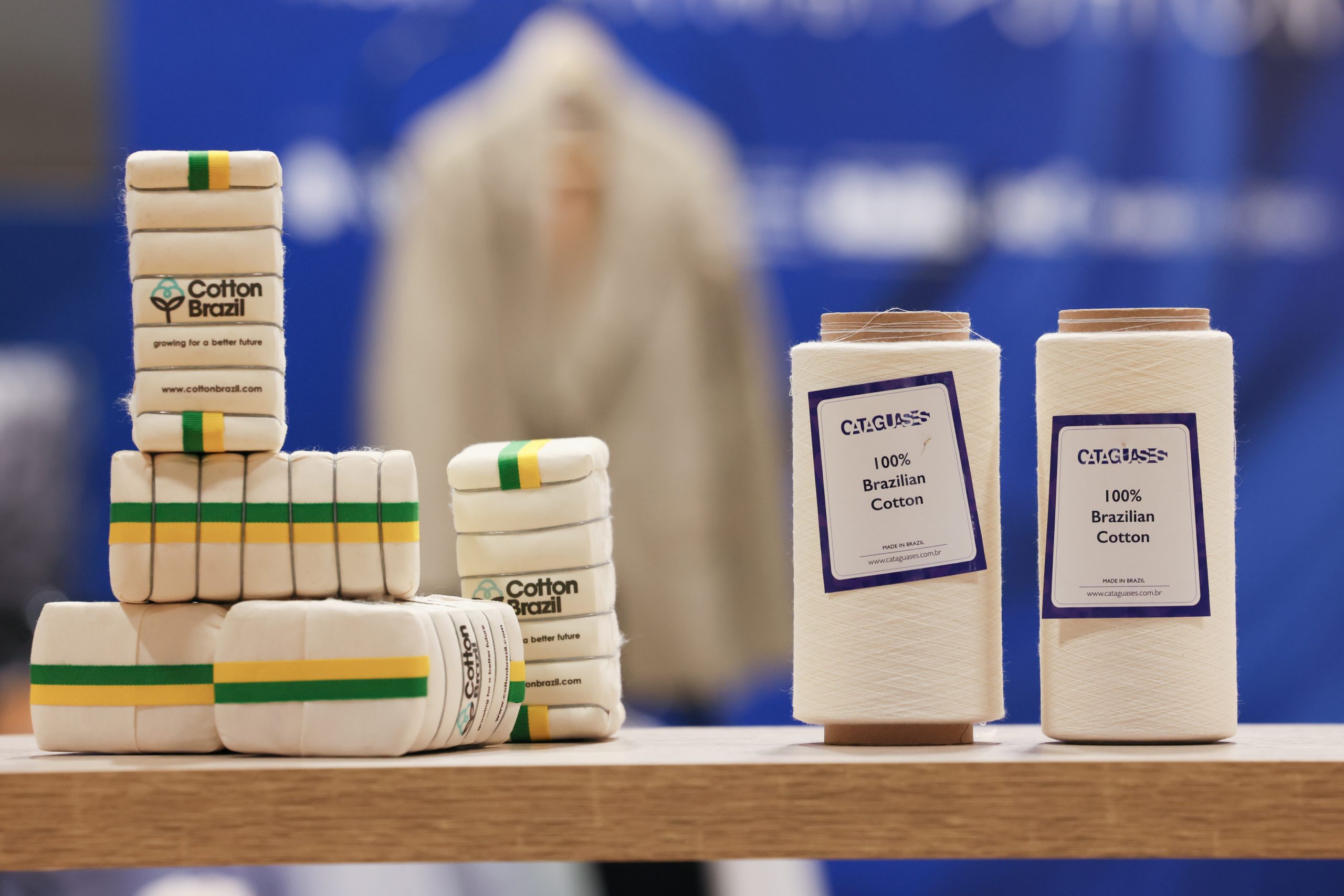
And as the leading provider globally of Better Cotton-certified cotton, Cotton Brazil is working with Better Cotton to jointly deliver on its commitment to full physical traceability.
In a context of supplier diversification and growing demand for sustainable supply chains, Brazil is likely to strengthen its position as a strategic partner in global cotton supply chains.
Brazilian Cotton’s Regulatory Advantage
George highlights that sustainability in itself no longer represents a competitive advantage: it is a sine qua non in terms of maintaining companies’ licence to operate in the European market.
“The notion of what ‘sustainability’ means has been the cause of much debate and legislation in the EU, and not least for textiles and apparel. What is absolutely clear is that it cannot be a mere marketing claim. The Empowering Consumers Directive stipulates that claims need clear, verifiable evidence. Under Green Claims Directive proposed rules, Better Cotton certification would be a recognised proof point for sustainability claims. Brazilian cotton alone represents by far the vast majority of the global Better Cotton certified cotton – almost half”, he stresses.
“That scale matters: brands usually prefer sourcing systems that can offer both volume and documentation, and the sustainability credentials of Brazilian cotton could indeed be one of the factors making it a ‘safer’ choice for brands & retailers complying with EU regulations. If a brand or retailer wants cotton with an established certification framework, third-party audits, and a large available supply base, Brazilian cotton is well positioned relative to other origins where verified sustainable supply is smaller or harder to trace”.
For the CEO of My Friday Strategic Advisory srl, the difficulty however lies in the complex textile supply chain, which makes full physical traceability from garment to fibre origin extremely challenging. Different initiatives seek to ‘solve’ this conundrum, but I think it’s fair to say that no one in the vast textile and apparel sector has yet cracked that nut.
“Without wanting to get too technical, other incoming European rules including Ecodesign for Sustainable Products Regulation (ESPR), Extended Producer Responsibility, and the Corporate Sustainability Reporting Directive (CSRD) and Corporate Sustainability Due Diligence Directive (CS3D) also present both opportunities and challenges. So certification alone may not be enough. It can support sourcing decisions, but EU due diligence and reporting requirements will mean Brazilian cotton gains an advantage in Europe when certification is coupled with credible evidence on traceability, labour practices, environmental performance, and continuous improvement – across the value chain.”
Next steps for the agreement
After more than 25 years of negotiations, the Mercosur–European Union agreement was signed on January 17 by leaders of both blocs. However, the text still faces institutional steps in Europe. The European Parliament has decided to refer the agreement to the Court of Justice of the European Union, which may delay its full implementation.
Although most EU member states support the agreement, it still faces resistance from some countries, such as France. President Emmanuel Macron, for example, has criticized the acceleration of the process.
If the Court validates the terms of the agreement, the text will proceed to a final vote in the European Parliament. Meanwhile, provisional application may take place among countries that have already completed their internal procedures, such as Brazil.