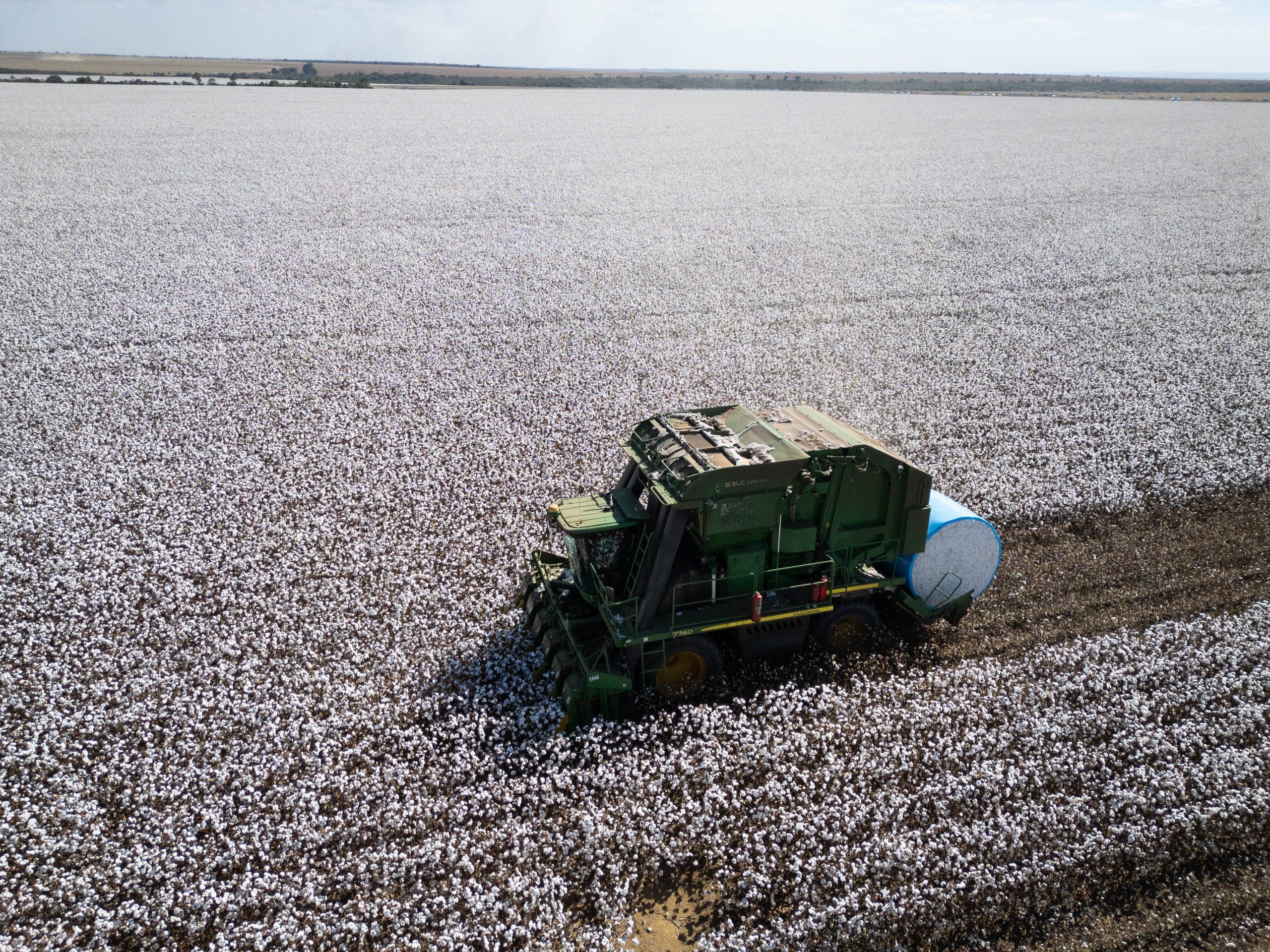
From the transformation of the production chain to the growth of exports, Brazil has consolidated its international presence supported by quality, sustainability, and traceability
Over the past few decades, Brazilian cotton production has undergone a profound transformation. In just over two decades, Brazil has become the world’s leading cotton exporter, gaining ground through scale, innovation, sustainability, traceability, and quality.
In September, the month in which Brazil celebrates its Independence Day, Cotton Brazil highlights how Brazilian cotton has gained ground in the global market.
Record exports
The latest figures help illustrate the scale of these achievements. In the 2025/26 marketing year, which ended in July 2026, Brazil exported 3.374 million tonnes of cotton, 19% more than in the previous cycle. Revenue reached US$5.3 billion, a record for cotton exports.
China was the main destination, accounting for 770.5 thousand tonnes, around 23% of Brazilian shipments. Shipments to the country increased by 309.2 thousand tonnes compared with the previous marketing year. Bangladesh also increased its purchases, with a rise of 173.2 thousand tonnes. On the other hand, Vietnam and Pakistan recorded the largest declines, of 137.4 thousand tonnes and 79.2 thousand tonnes, respectively.
“The export results show how Brazil has achieved a leading position in the international cotton trade and continues to expand its presence among the main importing markets. This trajectory was only possible thanks to the unity of growers around quality, sustainability, and traceability,” says Gustavo Piccoli, president of the Brazilian Association of Cotton Growers (Abrapa).
Sustainability
Sustainability is present at every stage of the chain. The traceability system developed by Brazilian growers captures data from the earliest stages of production, allowing brands and consumers to understand not only where the cotton was processed, but also how it was produced.
The Abrapa Identification System (SAI) is among the platforms that provide bale-by-bale traceability and detailed, reliable data for the value chain. The identification system makes it possible to track the fiber from the field to the spinning mill, providing information on origin, agricultural practices, and sustainability indicators.
Brazilian production also relies on the Responsible Brazilian Cotton (ABR) program, the country’s national standard for the social and environmental certification of cotton. The protocol verifies environmental, social, and economic aspects of production, with independent audits carried out on participating farms.
ABR also maintains a partnership with Better Cotton (BCI). Since 2013, the two organizations have worked together, and the criteria of the Brazilian program are benchmarked against the requirements of the international certification. Since then, Brazil has become the world’s largest producer of Better Cotton.
To learn more about the programs and practices that guide responsible cotton production in Brazil, visit the Responsible Brazilian Cotton (ABR) website.
Traceability
Traceability is one of the distinguishing features of Brazilian cotton production. Through SAI, the sector provides full traceability for 100% of Brazilian cotton production. Each bale receives a unique identification number, a barcode, and a QR Code.
The system digitally records a unique Bale ID, and each code provides access to information such as the farm and crop year, the cotton gin, the classification laboratory, and the results of HVI fiber quality tests.
The Bale ID also indicates certification under the Responsible Brazilian Cotton (ABR) program and the equivalent Better Cotton (BCI) standard. The data are available through an online platform and a mobile app, increasing transparency and facilitating access to information.
Another aspect that supports Brazilian traceability lies in the structure of the chain itself. Around 80% of the 266 active cotton gins in Brazil are fully integrated into the production process on farms. Located directly on the properties, they carry out ginning at the source, an important component in ensuring end-to-end traceability and preserving the accuracy and reliability of data throughout the chain.
Quality
Traceability also strengthens the ability to understand and demonstrate the quality of Brazilian cotton. As each bale has its own identification, the data associated with the product include the results of HVI tests, which provide information on fiber quality.
This means that the identification not only shows where the cotton came from, but also provides information on its quality characteristics, including UHML length, uniformity index, micronaire index, resistance in grams per tex, degree of reflectance (Rd), and degree of yellowness (+b). Every month, Abrapa produces a report compiling information from quality analyses of the current crop. Access the latest report at: Cotton Brazil Quality Report. This combination of traceability and quality data provides greater transparency across the chain and enables its different links to access reliable information about Brazilian cotton.
For the 2025/26 crop, production is estimated at approximately 4.144 million tonnes of cotton lint, according to an update presented by Abrapa.
In a chain that is increasingly connected to global demands, all this attention to production, origin, and quality reinforces Brazil’s ability to offer a competitive and reliable fiber to the global textile industry.