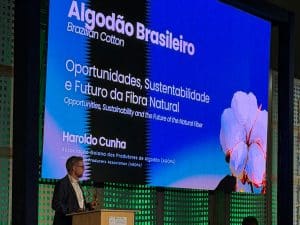
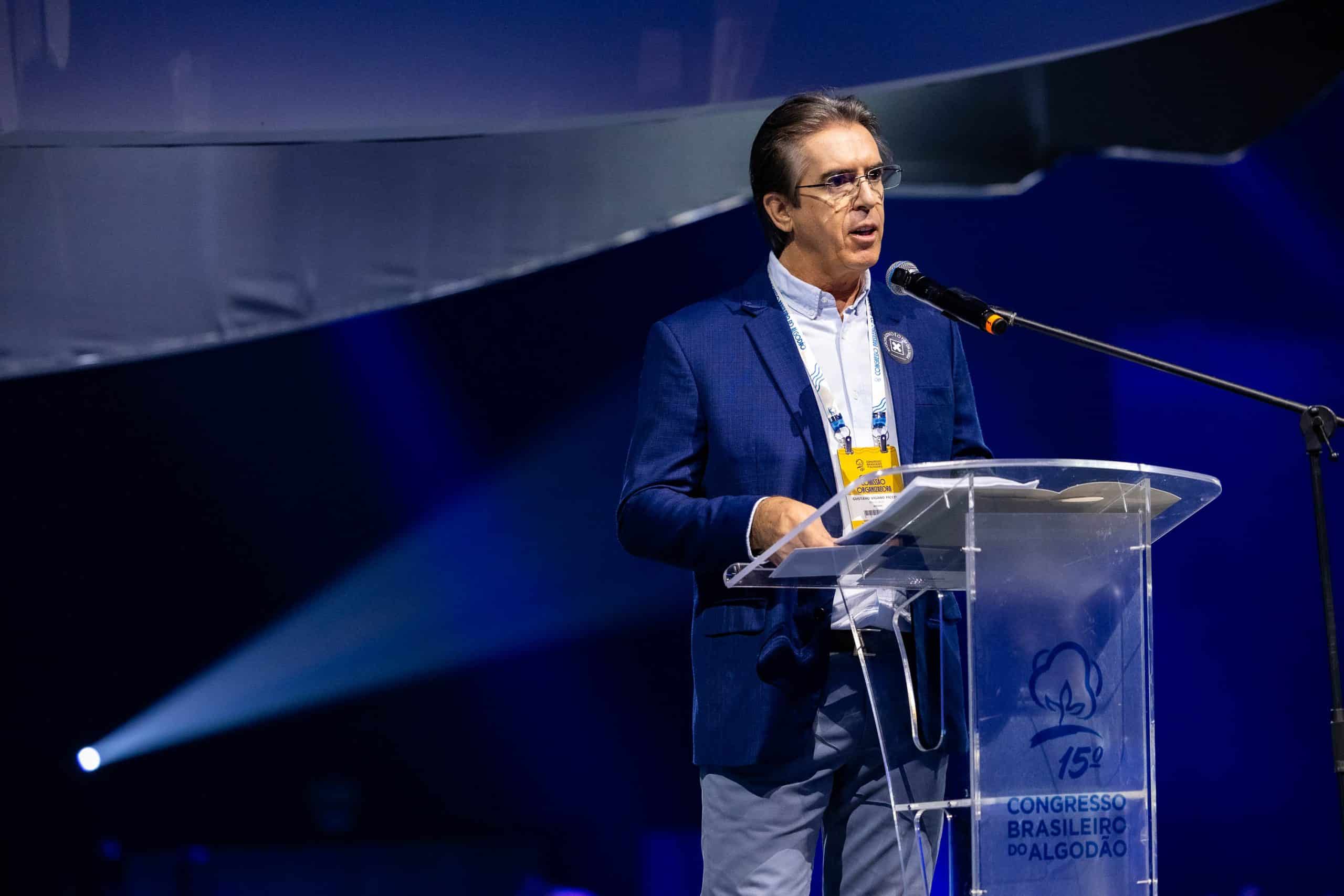
Abrapa President Gustavo Piccoli shares the main topics addressed at the Congress, from production challenges and new technologies to consumption, synthetic fibers and the growing presence of Brazilian cotton in international markets
Brazil is producing and exporting more cotton than ever. At the same time, cotton has been losing ground to synthetic fibers in the domestic market for the past decades. This contrast was one of the issues discussed at the 15th Brazilian Cotton Congress (CBA), held from September 22 to 24 in Belo Horizonte, Minas Gerais, and reflects the range of challenges facing the sector today.
While one of the plenary sessions explored the growth of synthetic fibers, microplastics and the role of public policies, others focused on challenges that emerge much earlier in the production chain, including climate stress, plant nutrition, genetics, water availability and the adoption of new technologies.
The opening ceremony was attended by Brazil’s Minister of Agriculture and Livestock, André de Paula, who highlighted the importance of the Congress as a space for bringing together growers, researchers, companies, public authorities and other representatives of the cotton supply chain. The program combined scientific knowledge and practical experience, addressing issues across different stages of the industry.
A national plan for Brazilian Cotton
At the CBA, the plenary session “How to Reconnect Brazilians with Natural Fibers? A Public Health, Environmental and National Strategy Challenge” brought into focus two trends moving in opposite directions. Cotton lint production is estimated at 4.1 million tons for the 2025/26 crop year, with around 20% expected to supply the domestic industry.
In 2025, approximately 0.7 million tons of cotton were consumed by the Brazilian textile industry, while imports of synthetic fibers reached around 2 million tons. According to figures presented at the Congress, cotton’s share of final consumption in Brazil fell from approximately 40% in 2015 to 25% in 2025.
According to Gustavo Piccoli, President of the Brazilian Association of Cotton Growers (Abrapa), the figures highlight a growing contrast. On the one hand, Brazil has expanded its capacity to produce and export cotton. On the other, the fiber has lost ground in the domestic market amid the growing use of synthetic materials.
“The plenary session took this scenario beyond industry figures. The growth in the use of synthetic fibers was discussed in connection with the presence of microplastics and with the environmental and health impacts presented during the panel, bringing apparel and raw materials into a broader discussion involving science, the environment and consumer choices,” he says.
The issue gained prominence at this year’s Congress with the official launch of the “Microplastic Is the End of the Line” campaign, an initiative by Abrapa in partnership with organizations representing other natural fibers. The campaign was created to raise awareness and encourage discussion about the fibers present in clothing and their impacts.
Public policies were also part of the discussion. International experiences provided examples involving cotton research and promotion, government procurement, taxation and mechanisms to encourage the use of natural fibers. These cases served as a starting point for discussing which policy instruments could be considered in light of Brazil’s own circumstances.
“The question that emerges from this set of data is particularly relevant to the sector: how can we bring the productive strength achieved by Brazilian cotton closer to the reality of consumers in Brazil itself?” asks the president.
Science, technology and productivity
While one part of the Congress examined the fiber after it leaves the farm, the scientific program focused on a fundamental question: how can productivity be maintained in increasingly complex production environments?
Panels on plant physiology, climate, water availability, temperature, nutrition and diagnostics explored how cotton responds to different conditions and how management can be adjusted accordingly. Discussions highlighted that higher fertilizer use does not necessarily translate into higher yields, as soil characteristics, water availability, root development, crop history and nutrient response all influence results.
“Records accumulated over different crop seasons help interpret these relationships and adjust management practices. Understanding the particular characteristics of each area is essential to pursuing productivity while using resources more judiciously,” Piccoli says.
Genetics, seeds, biotechnology and digital agriculture added other dimensions to the discussion. Experts examined how genetic potential interacts with environmental conditions and management, while sensors, artificial intelligence, data analysis and variable-rate applications can help identify differences within production areas and guide more targeted interventions.
Water management was also discussed in relation to irrigation, climate variability, production expansion and economic sustainability. For researchers, managing water also means managing risk, requiring producers to consider technical and economic feasibility, resource use and the characteristics of each production system.
A sector with a broader agenda
“Taken together, the topics addressed at the 15th CBA reveal different dimensions of an industry that has gained scale and international relevance. In the field, physiology, nutrition, genetics, water and digital tools influence how cotton is produced. Beyond the farm, other challenges emerge: industry, materials, consumption, environmental impacts and public policies,” Piccoli highlights.
According to him, this breadth reflects the transformation of Brazilian cotton production. The country has strengthened its position among the world’s major producers and exporters, while buyers and international markets are paying increasing attention to product origin, production practices and transparency across supply chains.For
Piccoli, addressing these challenges requires contributions from different parts of the value chain.
“Scientific research, knowledge produced on farms and technological development each have their own roles to play. Industry, retail, civil society organizations, public authorities and consumers come into play when the discussion reaches the fiber’s destination and use. From managing a crop to what reaches our wardrobes, the 15th CBA showed the extent of the choices surrounding Brazilian cotton today and why understanding them is part of the path toward sustaining its relevance both within Brazil and abroad,” he concludes.