Cotton Brazil Outlook Vietnam events brought together the world’s largest cotton exporter and the leading global importer of the fiber, strengthening trade relations between Brazil and Vietnam
With the goal of fostering knowledge exchange and strengthening trade relations with one of the most strategic markets in the global textile industry, Cotton Brazil carried out an institutional visit to Vietnam from May 24 to 26. The agenda included meetings in Hanoi and Ho Chi Minh City with representatives of Vietnam’s textile value chain, local authorities, and industry executives.
The event brought together two key players in the global cotton market. On one side was Brazil, which has consolidated its position as the world’s largest cotton exporter. On the other was Vietnam, currently the world’s largest cotton importer and one of the leading global hubs for the textile industry.
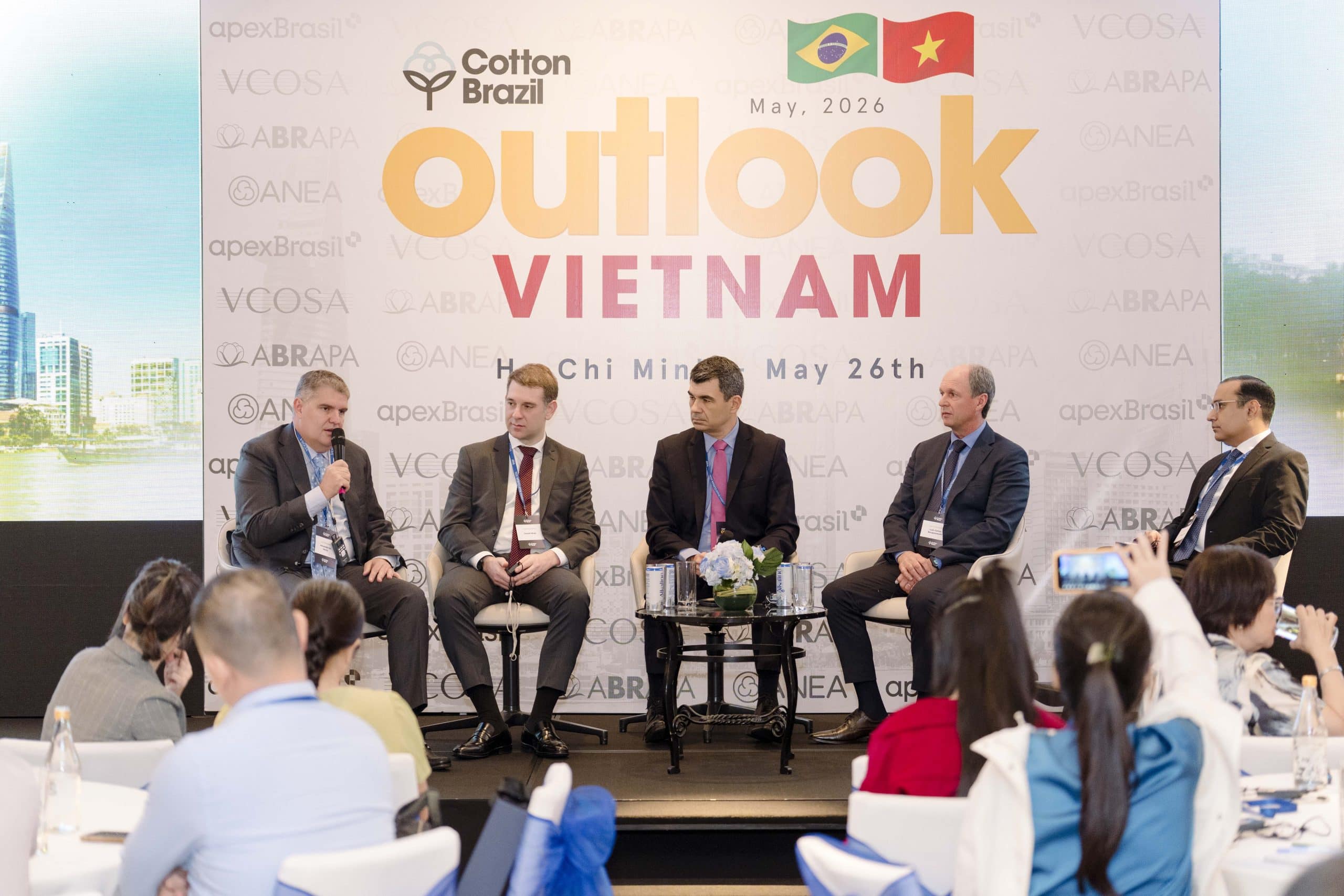
This marked the third time that Cotton Brazil — a program developed by the Brazilian Cotton Growers Association (Abrapa) and the National Cotton Exporters Association (ANEA), with support from the Brazilian Trade and Investment Promotion Agency (ApexBrasil) — has carried out activities in the Asian country. Throughout the agenda, the delegation hosted the Cotton Brazil Outlook Hanoi 2026 and Cotton Brazil Outlook Ho Chi Minh City 2026 events, aimed at promoting Brazilian cotton and creating new business opportunities between Brazil and Vietnam. The events brought together representatives from the textile industry, trading companies, spinning mills, and other stakeholders across the supply chain.
“The activities carried out in Vietnam reinforced the close relationship between our countries and demonstrated the potential to further expand this partnership. Our message is clear: Brazilian cotton growers are ready to supply high-quality, sustainably produced cotton to meet the demands of one of the most dynamic textile industries in the world,” said Celestino Zanella, Vice President of Abrapa.
A Strategic Market
During the meetings, the Brazilian delegation presented the key strengths of Brazilian cotton, highlighting attributes such as quality, reliability, traceability, and supply capacity. The agenda also provided an opportunity to showcase how Brazil consolidated its position as the world’s largest cotton exporter, driven by investments in technology, productivity, and stronger international trade relations.
The two countries maintain a close trade relationship in the sector. Vietnam ranks among the top five buyers of Brazilian cotton, amid a scenario marked by the strengthening of its domestic industry and growing demand for high-quality raw materials to supply one of the world’s largest textile and apparel manufacturing hubs.

Expanding Trade Relations
Between August 2025 and April 2026, Vietnam imported 294,600 tons of Brazilian cotton, representing approximately 11% of Brazil’s total cotton shipments during the period, according to ComexStat data. Brazil currently accounts for around 32% of Vietnam’s cotton imports.
Vietnam closed 2025 with GDP growth of 8% and projects a minimum expansion of 10% in 2026, supported by controlled inflation and increased foreign direct investment.
According to USDA data for the 2025/26 crop season, Vietnam ranks fifth globally in cotton consumption, with approximately 1.7 million tons, while also leading global cotton imports during the same period.
Institutional Meetings
The agenda included strategic meetings with VCOSA (Vietnam Cotton and Spinning Association), Cotton Brazil’s local partner in Vietnam, and VITAS (Vietnam Textile and Apparel Association), an organization representing approximately 1,000 companies in the Vietnamese textile sector and maintaining close relationships with major global brands and retailers.
The 2026 edition recorded the highest level of participation ever achieved by a Cotton Brazil initiative in Vietnam. According to a VCOSA report, 175 registrations and 156 in-person participants were recorded across the events held in Hanoi and Ho Chi Minh City, bringing together representatives from the entire Vietnamese textile value chain.
Interest in technical training initiatives was also evident. A survey conducted by VCOSA after the events showed that 85.7% of participants expressed interest in joining a technical workshop focused on improving spinning mill performance using Brazilian cotton.
The survey also revealed that 75.5% of participants intend to purchase Brazilian cotton within the next 12 months, reinforcing the Vietnamese industry’s strong interest in cotton produced in Brazil.
The increase in purchase intention compared to the percentage of companies that had already purchased Brazilian cotton over the past two years (63.5%) reflects the growing confidence of the Vietnamese industry in Brazil as a reliable supplier and strategic partner for raw material sourcing.
According to VCOSA’s assessment, the Vietnamese market now views Brazilian cotton not only as an alternative origin but also as a strategic supplier. Discussions are no longer centered on introducing Brazilian cotton to the market, but rather on topics such as reliability, sustainability, traceability, and long-term cooperation.
“The results show that Brazilian cotton is already well established in the Vietnamese market, but there is still room to expand our presence. The interest demonstrated by participants reinforces the local industry’s confidence in the quality, reliability, and supply capacity of our fiber — attributes that have strengthened Brazil’s position as a strategic partner for Vietnam’s textile sector,” said Marcelo Duarte, Abrapa’s International Relations Director.
The agenda also included the participation of the Brazilian Embassy in Vietnam, including Ambassador Marco Farani and representatives from Brazil’s agricultural sector in the country.