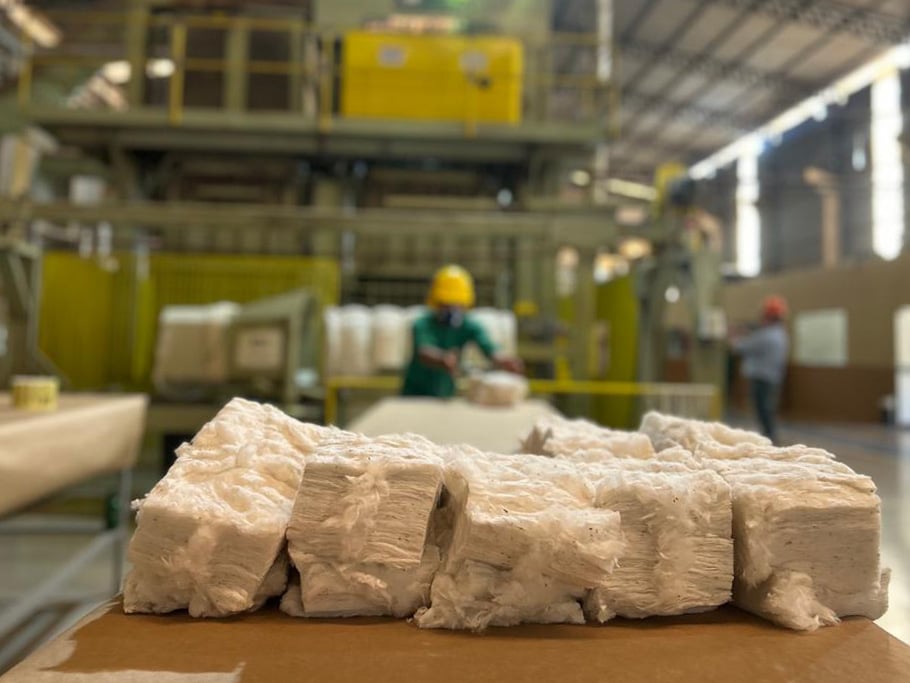
The Brazilian Cotton Quality Program integrates certification, quality data, and bale-level traceability, strengthening international buyers’ confidence in Brazilian cotton.
Brazil’s rise to become the world’s leading cotton exporter has been driven by continuous investments in quality, sustainability, and traceability. A key driver of this progress has been the Brazilian Cotton Quality Program (PQAB), one of the country’s most important initiatives for advancing cotton production.
Developed by the Brazilian Cotton Growers Association (Abrapa) in partnership with Brazil’s Ministry of Agriculture and Livestock (MAPA), the program enhances the reliability of the information accompanying Brazilian cotton, from each bale’s origin to the laboratory-generated quality data.
For growers, trading companies, textile manufacturers, and international buyers, the PQAB provides an additional level of assurance. The program integrates individual bale identification, sampling procedures, laboratory testing, HVI classification data, and official certification issued by the Brazilian government, helping ensure that cotton traded meets internationally recognized standards for quality and traceability required by the global textile industry.
Data from the 2024/25 crop season illustrate the scale of the program. According to Abrapa, 19.3 million bales were registered in the Abrapa Identification System (SAI), the platform that enables individual identification and traceability of cotton bales produced in Brazil.
Of these, 17.4 million bales were classified through the Brazilian High Volume Instrument Classification System (SBRHVI), which generates technical fiber quality data through laboratory analysis.
Within this total, 6.32 million bales received PQAB certification—equivalent to approximately one-third of all cotton bales produced in Brazil and 36% of the bales classified through the SBRHVI system. Altogether, 6.7 million bales were evaluated under the program, achieving a 93.03% national approval rate.
Created to ensure the reliability of cotton classification and strengthen production traceability, the Brazilian Cotton Quality Program (PQAB) brings together growers, cotton gins, classification laboratories, and accredited inspectors within a coordinated quality assurance system managed by Abrapa in partnership with MAPA.
Reliable Data for Recognized Cotton Quality
Using information generated through the SBRHVI system, the program monitors fiber quality, verifies compliance with official classification procedures, and promotes standardized processes throughout the production chain. The result is greater reliability, enhanced traceability, and continuous improvement in the quality of Brazilian cotton.
According to Silmara Ferraresi, Abrapa’s Director of Institutional Relations, the partnership between Abrapa and the Ministry of Agriculture has played a fundamental role in raising the quality standards of Brazilian cotton. “This cooperative model has been instrumental in transforming Brazil’s cotton industry. Improvements in quality have enabled the country to meet the requirements of the world’s most demanding markets, strengthening the reputation of Brazilian cotton and enhancing its international competitiveness.”
Deninson Lima, Abrapa’s Quality Manager, emphasizes that the PQAB is one of the pillars supporting the competitiveness of Brazilian cotton. “By connecting traceability and quality, the program helps ensure that Brazilian cotton reaches international buyers not only in large volumes but also with recognized standards of excellence.”
A Competitive Advantage for the Global Textile Industry
For the textile industry, certification provides an additional guarantee of transparency and credibility for the information accompanying Brazilian cotton. For growers, it offers access to tools that support continuous quality improvement. For Brazil, it reinforces a strategy that combines technology, governance, and traceability to sustain the country’s leading position in the international cotton market.
In an increasingly demanding global market where origin, quality, and transparency matter more than ever, the PQAB helps position Brazilian cotton as a fiber that can be traded with greater confidence.
The program demonstrates that Brazil’s competitiveness is built not only on production volume but also on its ability to consistently deliver standardized, traceable, and officially certified cotton to international buyers.
How to Purchase Brazilian Government-Certified Cotton
International buyers interested in purchasing Brazilian cotton with official government quality certification should request bales certified under the PQAB during commercial negotiations with growers, cooperatives, trading companies, exporters, or cotton brokers.
Cotton purchases continue to be conducted through traditional commercial channels. The program’s role is to provide an official layer of quality verification and traceability for the bales being traded.
In practice, buyers should request the following from their supplier:
- the SAI code, barcode, or QR code for each bale;
- the corresponding HVI quality data generated through laboratory analysis;
- traceability information identifying the bale’s origin, the cotton gin where it was processed, and the laboratory responsible for the analysis;
- confirmation that the bales are covered by PQAB certification;
- the Official Brazilian Cotton Classification Certificate, issued under the authority of MAPA.
Each bale identified through the SAI system carries a unique identification code that allows buyers to access information related to its origin and quality classification. Using these records, buyers, trading companies, and textile manufacturers can verify the traceability of the cotton purchased and confirm whether the negotiated bales hold official quality certification.
When purchasing Brazilian cotton, international buyers are encouraged to request bales certified under the PQAB and to obtain the official certification issued in Brazil, together with the SAI traceability documentation, before shipment.