Live broadcast hosted by Cotton Brazil brought together experts from Brazil and Portugal to discuss the key trends shaping the global cotton value chain
Cotton Brazil brought together Brazilian and Portuguese experts at the 23rd ANEA Cotton Dinner for a special live broadcast on June 26 to discuss the main challenges and opportunities facing the global cotton value chain. The program covered topics ranging from Brazil’s cotton crop outlook to the technological and regulatory changes expected to shape the competitiveness of natural fibers in the coming years.
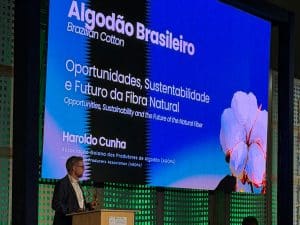
The event opened with a presentation on Brazil’s cotton crop outlook by Heloisa Melo, from Agroconsult, alongside representatives from Cotton Brazil. The session provided an overview of the country’s production outlook and highlighted the position of Brazilian cotton in response to the growing global demand for sustainably produced fibers.
Sustainability Must Go Hand in Hand with Innovation
Raul Fangueiro, Vice-Rector for Innovation, Entrepreneurship and Knowledge Transfer at the University of Minho, then delivered the presentation “Natural Fibers: Sustainability and Performance,” emphasizing that the future of cotton will depend on combining sustainability, technological innovation, traceability and the development of higher value-added products.
According to the expert, although cotton offers significant advantages as a renewable, biodegradable and comfortable fiber that does not generate microplastics, its natural origin alone is not enough to guarantee sustainability. A comprehensive assessment must consider the fiber’s entire life cycle, including water consumption, crop protection products, energy use, chemical inputs, wastewater generation and recycling processes. In this context, Fangueiro stressed that the sector must expand investments in research, development and innovation to meet evolving market demands.
He also highlighted the growing competition from alternative natural fibers and, particularly, regenerated cellulosic fibers, which are gaining ground in technical applications and high-performance products. In his view, cotton must move beyond its traditional role as a commodity and evolve into a technological platform capable of delivering greater added value.
Among the opportunities presented were the use of cotton residues for nanocellulose production, advances in recycling technologies and the development of functionalized cotton through nanotechnology, biotechnology, microencapsulation and surface engineering. These innovations can provide cotton with antibacterial, conductive, sensory and protective properties, expanding its applications in healthcare, biomedicine, sportswear, personal protective equipment and technical textiles. Fangueiro noted that Brazil has the scale, expertise and production capacity needed to lead this transformation.
European Regulations Increase the Need for Traceability and Transparency
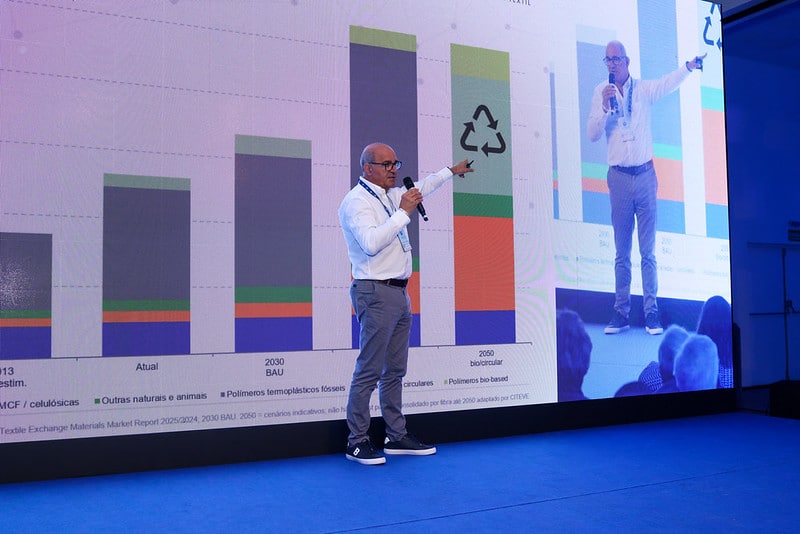
The second presentation was delivered by António Braz Costa, Director-General of CITEVE (Portugal), who outlined the regulatory changes being introduced by the European Union and their implications for the global textile industry.
During his presentation, Braz Costa explained that the European Union is implementing a strategy centered on sustainability, circularity, transparency and reducing dependence on fossil-based raw materials. The new framework includes regulations on ecodesign, chemical management, greenwashing prevention, extended producer responsibility, recycling, repairability and waste management, affecting not only European companies but all products placed on the European market.
One of the key topics was the Digital Product Passport, a tool that will consolidate information on raw material origin, water consumption, carbon emissions, chemical substances, certifications and other production-related data. Although Brazil exports relatively small volumes of cotton directly to Europe, a significant share of Brazilian cotton reaches the European market after being processed in countries such as China, Vietnam, Bangladesh, Türkiye and India. As a result, European requirements are expected to extend to Brazilian suppliers through international buyers and manufacturers, making traceability and data management increasingly strategic for maintaining competitiveness.
Braz Costa also addressed the growth of regenerated cellulosic fibers, such as lyocell, which offer advantages in industrial processing and functionalization. However, he emphasized that these fibers should not be viewed solely as competitors to cotton, but also as complementary solutions, including through the use of cotton residues as raw materials for new cellulosic fibers.
Research, Technology and Collaboration as the Path Forward
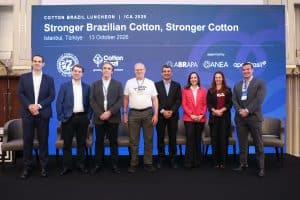
Closing the program, Raul Fangueiro and António Braz Costa took part in a roundtable discussion exploring the challenges and opportunities facing Brazilian cotton in an increasingly demanding global marketplace.
Among the key conclusions shared by the speakers was the need to strengthen traceability, organize and integrate production data, expand investments in research, innovation and recycling, and develop higher value-added products. They also emphasized that sustainability must advance alongside technology and transparency to ensure the continued competitiveness of Brazilian cotton in international markets, particularly in light of the regulatory changes underway in the European Union.
By promoting this discussion during the 23rd ANEA Cotton Dinner, Cotton Brazil reaffirmed its commitment to fostering knowledge exchange and strengthening dialogue across the global textile value chain, bringing together researchers, industry representatives and market leaders to discuss solutions that will contribute to a more innovative, sustainable and competitive future for Brazilian cotton.