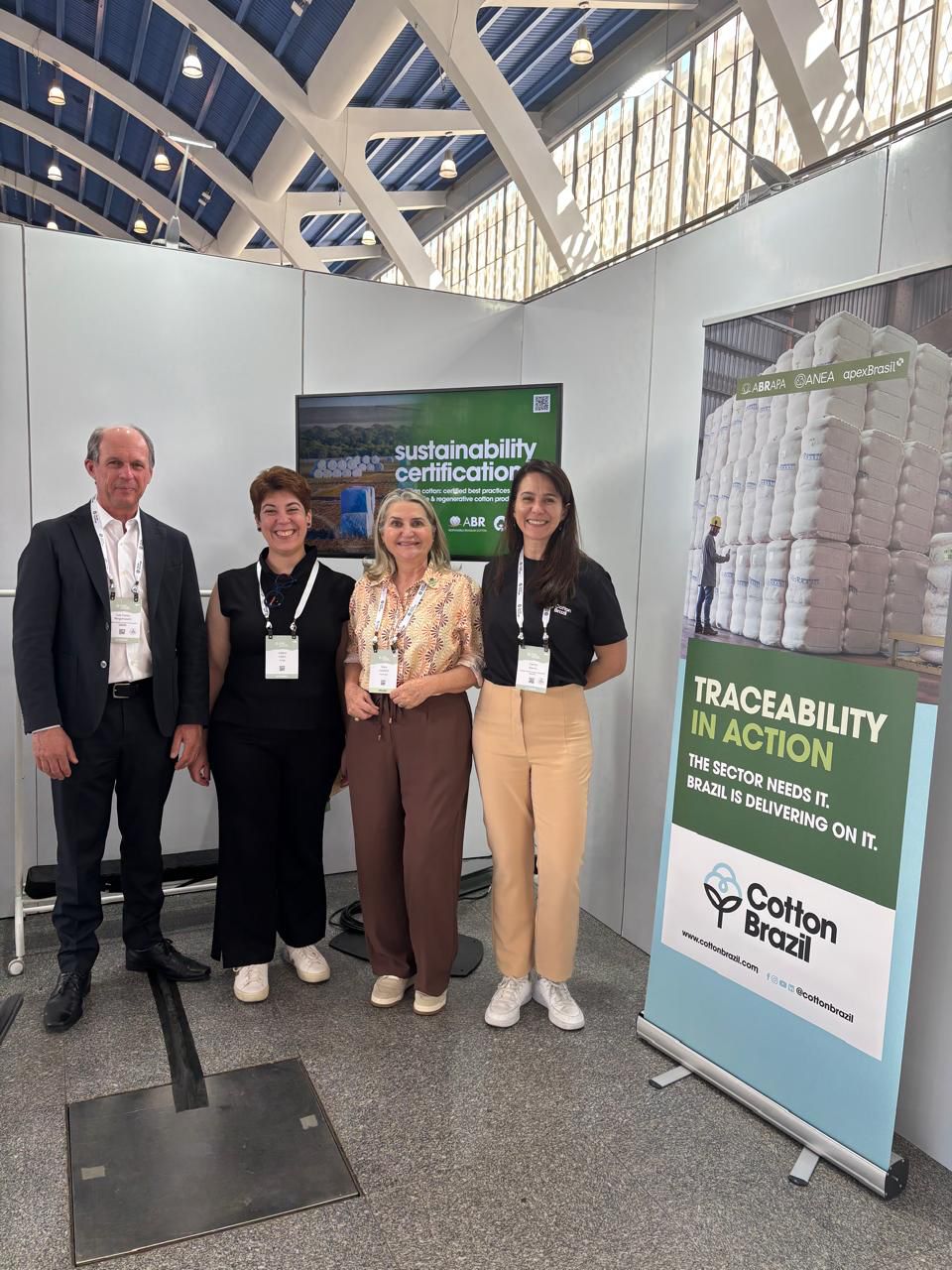
A Brazilian delegation coordinated by Abrapa demonstrated, using concrete examples, how Brazilian cotton can be sourced securely, sustainably, and traced by brands worldwide
The Brazilian Cotton Growers Association (Abrapa) was present at the Textile Exchange Conference 2025 in Lisbon, Portugal. The goal of the Brazilian delegation at the event—considered one of the most relevant in the global textile market—was clear: to warn against the rise in synthetic fibre consumption and show how Brazilian lint can contribute to a more sustainable and healthy fashion industry.
Fabio Carneiro, Sustainability Manager at Abrapa, explains that a significant portion of the actions currently being discussed globally to increase sustainability in clothing and textile product consumption is already part of the daily routine for Brazilian growers. “The interest in good agricultural practices for cotton production, including regenerative practices, brought many visitors to our stand. It was a fundamental opportunity for dialogue to listen to the sector’s demands and show how Brazil can contribute with different sustainability certifications and traceability,” he observed.
The annual Textile Exchange conference connects retail brands, non-governmental organisations (NGOs), and growers from around the world. Juliana Lopes, Director of ESG, Communication and Compliance at Amaggi, was part of the Brazilian delegation, representing the group—one of the largest in the country. According to her, the event highlighted that there is still a lack of knowledge regarding Brazilian cotton farming around the world.
“We noticed that many are surprised by all the work already being done in Brazil regarding traceability. In one-on-one meetings with brands, non-governmental organisations, and other institutions, we saw that few are familiar with Brazilian legislation and the grower’s day-to-day life. Our role was to share all this information,” she pointed out.
This view is shared by Camila Batata, Communication and Marketing Manager at Scheffer, another major group in the Brazilian landscape. “What is basic and routine for us still needs to be communicated to the global consumer market. Providing cotton traceability starting from the farm, for example, is seen as something innovative, even though it has been our reality for many years. Participating in this event allows us to carry this message forward,” she said.
Another point of great interest related to good cultivation practices. “The way we care for the soil, the massive use of technology in the fields, and regenerative agriculture catch people’s attention. These are routine on Brazilian farms, yet important segments of the sector are still unaware of this,” she commented.
This contact with brands, NGOs, and other sector organisations was also an exercise in listening. “At the same time as we publicise our good agricultural practices, innovation, and leadership in the sustainability of Brazilian cotton, we took the opportunity to listen to market demands so that our product continues to meet the new requirements of the industry and consumers,” observed Luiz Carlos Bergamaschi, cotton grower and board member of Abrapa.
Cotton Brazil
For two consecutive years, Brazil has been the world’s largest cotton exporter and the third-largest producer. In the 2024/25 cycle, which ended in July, the country shipped 2.83 million tonnes of lint, 6% more than the 2.68 million tonnes in 2023/24. The international promotion of the product is carried out by Abrapa through the Cotton Brazil programme, developed in partnership with the Brazilian Trade and Investment Promotion Agency (ApexBrasil) and supported by the National Association of Cotton Exporters (Anea).
Textile Exchange
This year, the theme of the Textile Exchange Conference was “Shifting Landscapes”, and the event was held from 13 to 17 October in Lisbon. Textile Exchange is a non-profit institution that promotes the use of fibres with lower environmental impact worldwide—among them, cotton.