
Advances in traceability and sustainability, as well as the importance of quality and reliability, were among the topics addressed
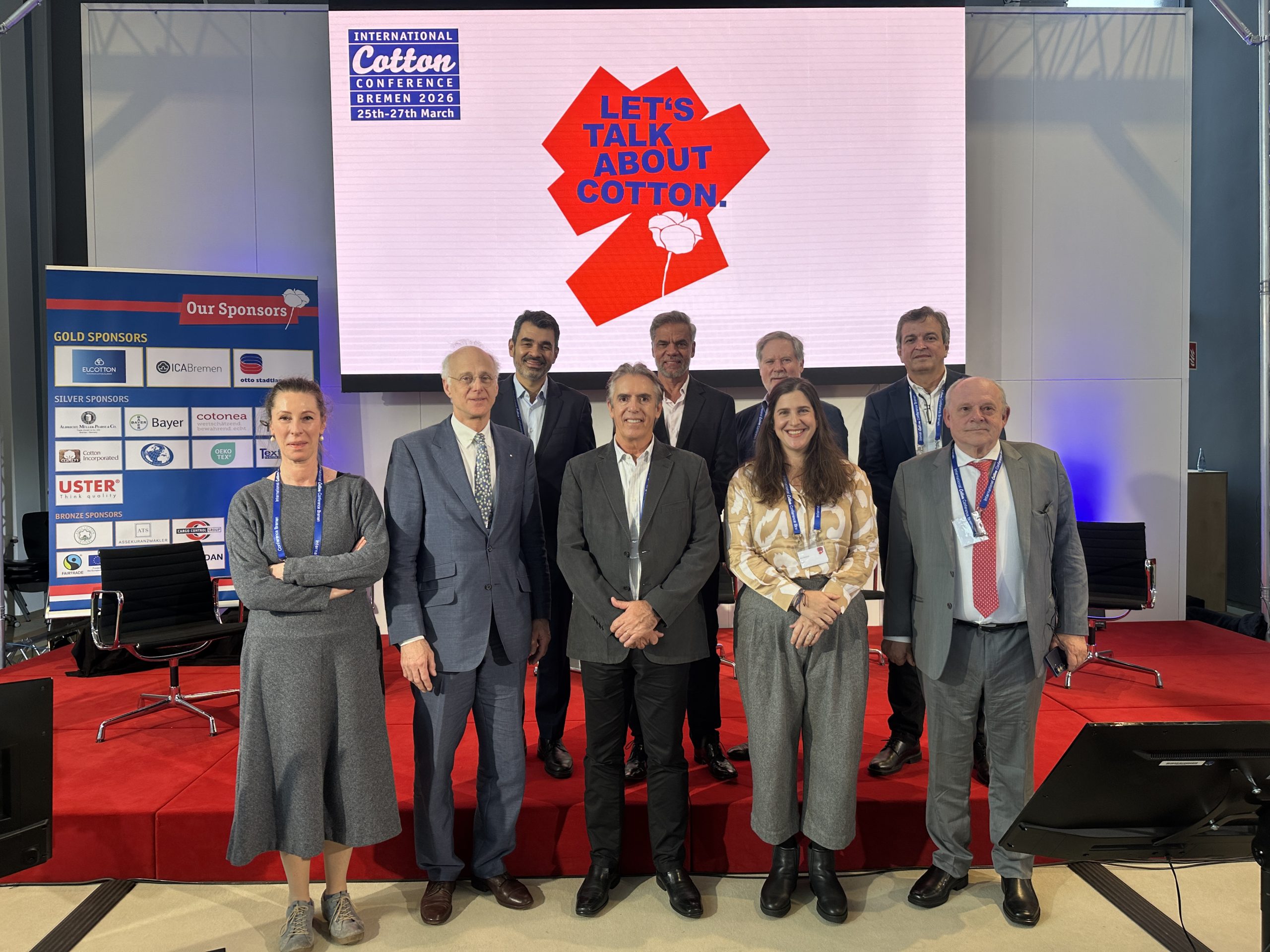
Cotton Brazil, alongside a Brazilian delegation, participated in the 38th Bremen International Cotton Conference in Germany, contributing to strategic discussions on the future of cotton. The group took part in three plenary sessions, following debates ranging from technical aspects of the fiber to global market trends and the growing demand for transparency in the textile chain. The trip was part of a broader agenda in the country, which also included participation in the 83rd ICAC Plenary Meeting.
The Brazilian presentation emphasized the need to act as a unified sector rather than as individual countries, as well as the importance of strengthening consistency, value, and sustainability. Brazil’s advances in traceability and sustainability, along with the importance of data quality and reliability, were also highlighted.
“The conference brings together, every two years, the main leaders of the global cotton sector. A sector in which Brazil is becoming increasingly prominent. Our participation in three panels at a forum where, until recently, we had no voice, demonstrates the strength and leadership that Brazilian cotton has achieved. More importantly, our presentations and contributions brought forward solid proposals,” said Marcelo Duarte, Director of International Relations at Abrapa (Brazilian Cotton Growers Association).
Economics – Beyond the Bale: the market story
The panel Economics – Beyond the Bale: the market story, featuring Abrapa’s Director of International Relations Marcelo Duarte, discussed the structural factors behind cotton’s declining share in the global textile fiber market and proposed strategic directions to reverse this trend.
“Although cotton continues to be widely preferred by consumers, its relative share has steadily declined over the past decades. This apparent contradiction shows that the challenge lies not in product acceptance, but in the sector’s ability to convert preference into effective and sustained demand,” Duarte noted.
The presentation highlighted that this loss of competitiveness is linked to factors such as stagnant supply, higher costs, limited supply chain coordination, and disproportionate pressure on cotton regarding environmental issues, while synthetic fibers benefit from scale and supportive public policies. In this context, it was reinforced that cotton does not compete on price but has unique attributes — such as being biodegradable, renewable, and comfortable — that must be better valued across the chain.
As a way forward, the panel emphasized the need for a more strategic and coordinated approach, focusing on productivity gains, logistical efficiency, strengthening sustainability with measurable data, and closer alignment with the end consumer.
“The challenge for cotton is not only productive, but strategic. It is about repositioning the fiber within a highly competitive market influenced by factors beyond the production chain. Overcoming this challenge requires a coordinated approach, based on data, institutional alignment, and effective market communication,” Duarte added.
“More than producing better, the global cotton chain needs to better understand demand, translate its advantages into perceived value across the entire chain, and above all influence the regulatory environment,” he concluded.
Traceable Cotton. Transparent Chain
In the Traceable Cotton. Transparent Chain plenary, Abrapa Advisory Board member Haroldo Cunha presented the SouABR program as one of the leading examples of Brazilian cotton’s progress in traceability and transparency. The initiative connects the entire production chain — from farm to fashion — through an integrated system that ensures control, reliability, and access to detailed information about product origin, strengthening Brazil’s credibility in the international market.
The model is supported by four strategic pillars — sustainability, traceability, quality, and promotion — which underpin initiatives such as ABR certification, the SAI identification system, and international promotion programs for Brazilian cotton. The SAI system enables precise tracking of each bale through internationally standardized codes, while ABR certification ensures strict environmental, social, and labor criteria, with independent audits covering the entire production unit.
The data presented highlighted the scale and relevance of the program, with around 83% of Brazil’s cotton production already certified and millions of tons tracked throughout the textile chain, including yarns, fabrics, and finished products. The central message was that Brazil is advancing in transforming cotton from a commodity into a higher value-added product, aligned with global demands for transparency, sustainability, and responsibility.
“It was a great opportunity to bring forward an important topic, which is traceability and sustainability. We have SouABR, which is innovative and pioneering in providing full traceability — from the field to the final product. I believe there is no other program with this level of detail. It was important to present it because it is an extension of the work that Abrapa has already been doing in advancing sustainability, quality, traceability, and promotion,” highlighted Haroldo Cunha.
“So, SouABR brings all of this together and serves as a reference for other models and origins, as well as for us, to continue strengthening this program — perhaps even through international efforts,” he added.
Cotton Quality and Testing
During the Cotton Quality and Testing panel, the presentation “Measurement Uncertainty for HVI Instruments”, delivered by Abrapa’s Quality Manager Deninson Lima, highlighted measurement uncertainty as a key factor in ensuring the reliability and credibility of Brazilian cotton in the international market. The presentation showed how applied metrology goes beyond a technical aspect, directly influencing data transparency and fiber competitiveness.
Lima presented Brazil’s robust classification structure, consisting of 13 laboratories, around 90 HVI (High Volume Instrument) machines, and the central laboratory CBRA, responsible for ensuring data standardization. He also emphasized that uncertainty evaluation follows international standards such as ISO/IEC 17025 and clarified the distinction between tolerance and uncertainty, reinforcing that uncertainty represents the level of confidence in each individual measurement — a critical factor for commercial and technical decisions.
“Traceability, ensured through international reference standards, is fundamental to the credibility of Brazilian cotton. When combined with effective measurement uncertainty management, it not only mitigates risks but also transforms data into reliable results. This is what strengthens the reputation of our cotton and reinforces Brazil’s position in the global market.”
Brazil’s growing presence on the global stage signals not only its production strength, but its commitment to shaping the future of cotton. The next step is clear: continue building partnerships, scaling traceability capacities, and reinforcing cotton as a responsible and sustainable choice for the global textile industry.